A Manifest on the Privatization of Knowledge and the Delay of Truth
DOI
12 February 2026
1 Professor emeritus. Frm head of the Research Group Cross-Cultural Injury Epidemiology, Karolinska Institute, Dept Public Health Sciences, Sect. Social Med., and frm Research Fellow at Dept Social Med. Harvard Medical School. 2 Copyright ©2026 Marcello Vittorio Ferrada de Noli CC Attribution 4.0 International
I. Collective Creativity and the Fiction of Individual Ownership, and How Corporations Copyright Restrict Knowledge
I have always been against the concept of copyright as it applies to corporate publishers and similar entities. It basically gives rights to them under the disguise of protecting authors’ rights. As an example, none of my articles published in medical indexed journals are easily accessed to fellow authors or the general public (unless they are requested directly to the journals by government or university institutions and the like). In my Research Gate page there is a list of researchers asking for reprints of my indexed articles ––I cannot provide those because I do not even have them myself.
With that said, with regard to authors, I am not a copyright anarchist. Of course, original work shall be always credited to the authors, as well as the media in which the work was originally published.
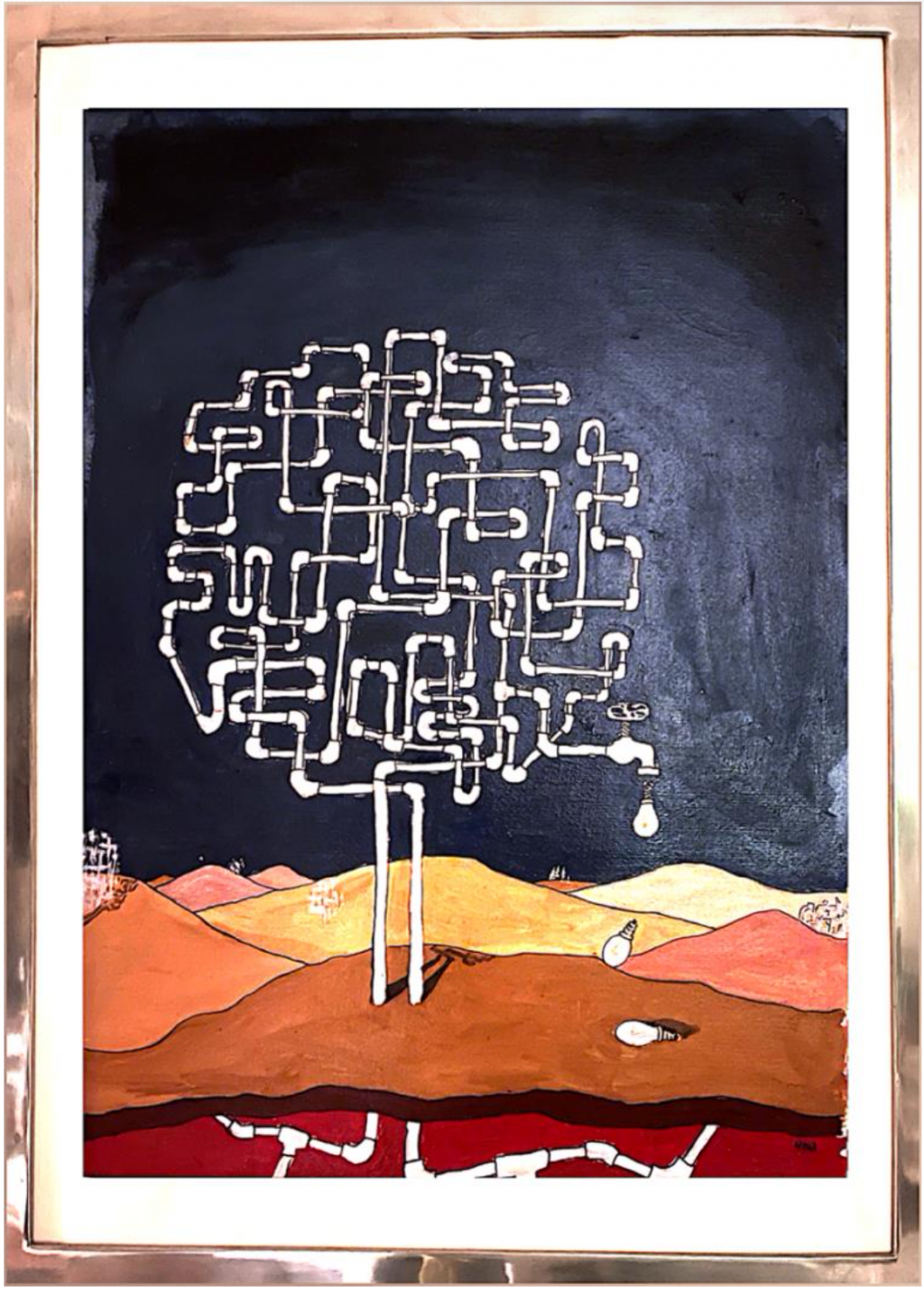
Why I regard commercial ‘copyright’ praxis as a sham ––such as authors claiming they “own” a certain discovery, or finding, or conclusion? Please observe these metaphoric details in my painting accompanying this text, “The Scientist and the Copyright” (Stockholm 1980):
Depicted at the centre of the painting is a ‘creative tree’. Inventions seems to flow as fruits –represented by bulbs falling onto the ground, destined to light up, and eventually serve as nutrient to the soil from they were born. However, the tree itself receives its nourishment from the production of other discovery trees scattered across the world. All trees are connected by a common earth and its underlying intricate system of reciprocal communications.
The piece was inspired by the following reflections I have had along the years:
II. Cultural Products and Scientific Innovations Are in Their Development Culturally Universal and Should Instead Be Regarded Collective Property.
The Swedish gallery of famous inventions can boast no less than 50 world-renowned artefacts besides dynamite, the invention reputed to Alfred Nobel. Some examples often mentioned are the shifting-spanner tool (“skiftnyckeln”, called also the “Swedish key” in Denmark or the “Little Swede” in Russia), the bulb, the propeller, etc. etc. The notion of celebrated creativity as a national trademark has been enhanced in Sweden by the prosperity achieved in the last years by domestic or multinational companies in the music business and which have given out songs created or interpreted by Swedish artists.
However, a closer view into the genesis of those discoveries, or of art and musical creations, would reveal that previous inventions made by others, previous art works and styles, etc. are invariably embedded in the process leading to the final product. And for this product would the author, the inventor or the artist, seek a patent, a copyright or any other form of “author’s right”. As if this final product would be his or her solely achievement.
A discovery is in fact the synthesis of a dialectical chain of discoveries, often conducted in parallel across different social formations, places, or different epochs in the history of man and experimental knowledge.
For instance, Alfred Nobel would not have been able to describe the properties of dynamite ––and to formulate its patent claim––without the prior discovery of nitroglycerin by the Italian scientist Ascanio Sobrero in 1847 (which he originally called pyroglycerin), or the even earlier discovery of guncotton by the professor at Turin University Jules Pelouze. Further, the scientific language used by those authors is of even elderly development and in which very many have contributed. Not to mention Johan Petter Johansson’s “skiftnyckeln” patent of 1891, created on the basis of Richard Clyburn’s invention of 1842 (reason for which in most of the countries the “Swedish key” is known in fact as “The English key”).
In the same fashion, the Swedish composer of a purported new pop song would use a certain genre, a rhythm- say for example hip pop – or a certain instrumentation, etc., which were essentially developed by others, elsewhere. How essential – versus accidental – are those previous elements for the “new creation”? The answer is simple, they are sufficiently essential as to the point that if they were not present in the “new composition” or “interpretation”, this could not be identified as such – say for instance as a hip pop hit -by their public.
In discussing the notion of original “Swedish” creativity as a “national” trait, I had the idea of painting a tree (see below) – as in the form of a brain – composed by an intricate system of connected tubes indicating the truly international, cross-cultural and collective communication that is instead at the foundation of so-called private inventions. To emphasize, besides the “trees” seen in the painting are absolutely connected in their roots with the roots of other trees scattered all over the visible segment of earth. No need to say, that for the actual painting I did use some already elaborated materials elsewhere ––techniques which have been in constant development or improvement through thousands of years. And by thousands of artists, artisans, and manufacturers which never claimed “copyright”!
III. Research as Social Duty, Not Career Capital
Research is meant to serve society, not society to serve researchers. Nor is research meant to serve corporate publishers’ profit.
I argue that there are some problematic issues in society that need a prompt address. There are, for instance, political or geopolitical decisions that are paramount taken after the interests of states ––being those of national security, economic, or other. However, the dialectics of political decisions is not function solely of the agenda of those in power. The pressure of an informed public is also a factor in those decisions, particularly via the voice of their elected representants in the democratic structure ––but even through popular demonstration outputs such as honest journalism, alternative publications, and social media.
Those issues cannot wait the analyses and information provided by peer-reviewed research articles that, from the moment they are designed, investigated, executed, submitted, peer-reviewed and finally published it can take, yes, years. And, ultimately, the access of those published findings is paywalled by corporate journals, included those entangled with professional or academic societies.
IV. Preprints and the Ethics of Time
Thus, research ethics ––which, in my view, fundamentally entails alignment with society–– may accordingly call on academics and investigators to publish their findings openly when the moment demands it, rather than waiting to produce critical retrospective analyses of the consequences arising from the fatal mismanagement of societal or geopolitical challenges.
That is why I advocate for contemporary academic analysis to be published promptly on online platforms or in preprint format. In doing so, we serve the fundamental task entrusted to us by society.
I can understand that an important co-motivation for researchers to have articles published in established (and/or corporate journals) is to advance their academic careers, even if the requirements have notably diminished with the years.
For instance, according to SITA Academy, doctoral students in the United States are required to have “just one published paper” to get a PhD, while other requires two or three. Harvard University Graduate School for Art and Sciences required “a published article or series of articles” for a PhD dissertation, and at Harvard University Dept of Health Studies three papers are mandatory for a PhD, although not all published. In the old-school academic culture of the Medical Faculty at the Karolinska Institute I had seven articles in my dissertation. Today, the requirements are one published article, one accepted for publication, and one in submission. The academic world changes!
Then the mid-career research people need some more publications for the assistant / associate professorships, and further several prestigious publications for a full professorship. All these amidst an increased competitive academic panorama. While from the moment of submitting a paper to its peer review and publication may take several months or even years: a paper in, for instance, humanities or social sciences, could take two years before it has been published. I have served as a peer reviewer in high-ranked medical journals, and I know the problem from walking in its own labyrinths.
Do not defer the result of your investigation you languish under the verdict of highly prestigious journals and their crème de la crème indexing. Preprint first. Avoid the copyright trap.
V. Militant Scholarship and Ethical Positioning
Easy for me to say, when after decades of academic and other kinds of battling in society, I became a professor emeritus.
But at least, to honour the authenticity of my stance, it has been so since ever. To be militant academic on the side of society is consistent with both previous societal engagements ––which have driven me twice to exile– and the elections of topics I had when I started to publish research work both in Latin America and in Europe (see author notes). Meaning: all what may advance the understanding the situation of the oppressed and poor segment of societies –never at the service of the oppressors.
This perspective regards scholarship as an ethically grounded practice, not as an abstract or neutral enterprise. it is rooted not in personal experience but in knowledge. It is not autobiographical, but epistemological.
References
Ferrada de Noli, Marcello. Post-traumatic Stress Disorder and Suicidal Behaviour in Immigrants to Sweden: An Epidemiological, Cross-Cultural and Psychiatric Study. Stockholm: Karolinska Institute, Department of Clinical Neuroscience, 1996. ISBN 91-628-1984-4.
Ferrada de Noli, Marcello. Alienación y Superestructura. Concepción: Universidad de Concepción, Departamento de Problemas de la Educación, 1969.
Ferrada de Noli, Marcello. Teoría y Método de la Concientización. 2nd ed. Monterrey, Mexico: Universidad Autónoma de Nuevo León, 1972.
Harvard University, Graduate School of Arts and Sciences. Guidelines for the PhD Dissertation. PDF. Cambridge, MA: Harvard University, March 2014.
Harvard University, Kenneth C. Griffin Graduate School of Arts and Sciences. Health Policy. Cambridge, MA: Harvard University, July 1, 2025.
Journalmetrics.org. Academic Publishing Timeline: From Manuscript to Publication. Accessed January 26, 2026. https://journalmetrics.org.
SITA Academy. Is Publishing a Research Paper a Requirement for PhD Graduation? Accessed January 26, 2026.
Author Notes / Publication Notes
1) A proposed formula –as appears in Libertarian Books Europe: “Works are published under a Creative Commons Attribution 4.0 International license. Are free to use, as long the authors are credited. All our books are free to read and download without cost, as we are against unjustified copyright profits. Reproduction of texts requires a full reference to authors, to Libertarian Books Europe, year, and the publication’s ISBN. Knowledge should be free and accessible!”
2) My first published research works in Sweden focused on suicidal behaviour and other forms of psychiatric and injury epidemiology, pertaining to human victims in society rather than the perpetrators of violence.